How to Turn Random Blog Posts Into a Steady Visibility System

If your blog posts feel disconnected from each other and from your offers, this episode shares exactly why that happens and walks you through the Cash Cluster structure from Diane Houghton, WP Basics Guide, that changes it.
Last Updated: 24 April 2026
You already know your business needs steady visibility. You sit down, write something thoughtful, publish it, and feel a small sense of relief that something moved forward. A few days later, you're back at the blank page, starting over from scratch. The post you published was helpful, though it sits on its own without leading anywhere. It doesn't connect to your other content, your offers, or a clear next step for your reader.
That pattern is the real problem. Your effort resets every time, and the gap between effort and momentum is where blogging starts to feel heavier than it should.
If you've already been trying to create steady visibility, scattered blog posts can make the whole process feel heavier than it needs to feel. Your message deserves a structure that helps readers move through your work with clarity.
Key Takeaways
Random blog posts reset your effort every time you publish. Structure compounds it.
A steady visibility system gives each post a role so your content works together.
Blog content structure supports both your reader and your search visibility at the same time.
A simple content system reduces the decisions you make every time you sit down to write.
Your blog becomes part of your sales process when energetic business clarity connects your content to your offers.

Why Random Blog Posts Never Create Steady Visibility
Each post is carrying too much weight
Random blog posts ask each piece of content to do everything at once. One post needs to attract attention, build trust, explain your work, and move someone toward your offer. That level of pressure makes content creation feel inconsistent even when you're capable and genuinely committed.
A steady visibility system removes that pressure. Your content works together as a connected structure instead of relying on a single post to carry everything. Each post has a role, and your visibility builds over time instead of resetting.
Search engines also rely on structure to understand your content. Google's SEO Starter Guide emphasizes clear organization, useful links, and helpful content that makes a site easier for readers and search engines to understand. That supports the whole point of a steady visibility system: your blog content structure should guide people through your ideas with less friction.
The hidden cost of disconnected content
Disconnected content increases decision load. Every time you open a blank page, you're deciding what to write, how to frame it, and how it connects to your business. That process repeats every time, which makes staying consistent harder than it needs to be.
Over time, this creates hesitation. You might notice yourself delaying writing or questioning your ideas before they're fully formed. The issue isn't your ability to create. Your content simply doesn't have a system to support it yet.
A simple content system gives each post a role. It reduces the number of decisions you have to make every time you sit down to write.
What a Steady Visibility System Actually Looks Like
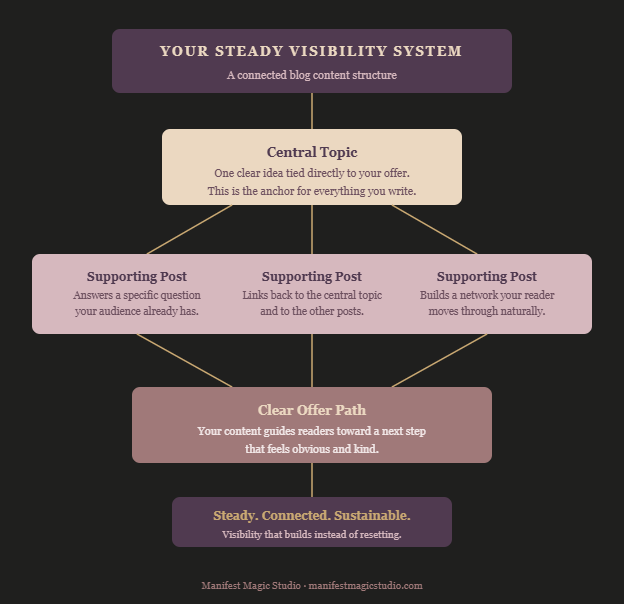
One central topic anchors everything
Your content revolves around one clear idea that connects directly to your offer. This becomes the foundation of your blog content structure and gives your audience a clear understanding of what you're known for. Choosing a central topic reduces decision fatigue because you're building within a defined direction rather than choosing from an endless pool of ideas.
Supporting posts that create connection
Supporting posts expand on your central topic by answering specific questions your audience already has. These posts link back to the main idea and to each other, creating a network of content instead of isolated pieces. Your reader can move from one post to the next naturally, and clarity builds with each step.
A clear path to your offer
Your content guides your reader toward a next step that makes sense. When your content is rooted in energetic business clarity, your blog becomes easier to connect to your offers. The reader can understand what you do, why it matters, and where to go next, without being pushed there.
For this topic, the natural next step is learning how to build that structure in a practical way. The Blogging Cash Cluster Workshop walks you through exactly that: register there to get a clear starting structure, your Cash Cluster Topic, and connected post ideas in one session.

Why Blogging Creates Stability That Social Content Can't
Social content moves quickly. You post, it gets seen for a short window, and then it disappears. That creates a cycle where your visibility depends on constant output.
A blog creates something more stable. Your content stays accessible, connects together, and keeps working after you publish it. Each post adds to your overall presence rather than fading. This shift changes how your visibility feels: you're building something that lasts instead of maintaining something that disappears.
How to Shift From Random Posts to a Structured System
Choose your central topic first
Start with one topic that connects directly to your offer and your audience's recurring problem. This becomes the anchor for your steady visibility system and makes future content decisions easier because you're building depth within a clear direction.
Build supporting posts around real questions
Create posts that answer specific questions related to your central topic. These questions often come from real moments of confusion or hesitation your audience experiences. Each post should contribute to the larger idea rather than standing alone, which builds a stronger blog content structure over time.
Connect your content intentionally
Link your posts together so your reader can move from one idea to the next without searching. This creates a guided experience that feels clear and supportive. Internal linking also strengthens your site structure, which helps search engines understand how your content fits together.

How This Connects to Steady Income
Your content shapes how your audience understands your work. When your blog content structure is clear, your audience can move from curiosity to clarity without confusion. This creates a more stable path to sales. Your blog becomes part of your sales process rather than a separate activity, and visibility starts to feel calmer because your content is supporting your business instead of creating pressure to perform.
If your content has felt scattered, that's a design issue with a clear solution. You can build a steady visibility system that supports your energy and creates momentum over time. You're continuing something, not starting over.
The Blogging Cash Cluster Workshop is free to attend. You'll define your Cash Cluster Topic, start your cornerstone content, and map supporting posts that connect back to your main idea. A workbook is included so you can turn your ideas into a clear plan during the session rather than leaving with notes you'll revisit later. The VIP pass lets you implement in real time, which reduces the gap between learning and taking action.
After your structure is in place, staying consistent becomes easier when you have ongoing support. The Intuitive Business Collective is a free community with calm systems and simple prompts that help you keep moving without increasing your decision load.
Frequently Asked Questions
How many blog posts do I need to create a steady visibility system?
You don't need a large volume of posts to begin. A steady visibility system starts with one clear central topic and a small group of supporting posts that connect back to it. Five to ten well-connected posts can create more momentum than dozens of disconnected ones. The goal is structure and connection, not output for the sake of output.
What is a Cash Cluster Topic and how do I choose one?
A Cash Cluster Topic is the main idea your blog content revolves around. It connects directly to your offer and the problem your audience is already trying to solve. You choose it by looking at what your clients come to you for, the questions they ask repeatedly, and the transformation your work provides. It should feel specific enough to guide your content and broad enough to support multiple posts.
Does my blog need to be consistent before it starts working?
Your blog starts working when your content is structured. A clear system allows each post to support the others, which reduces pressure on you to show up constantly. Staying consistent becomes easier when the structure is in place because you're continuing a system rather than starting from scratch each time.
How long does it take for a blog to bring in traffic or clients?
A structured blog builds momentum over time. Some posts may start getting traffic within weeks, while others take longer to gain traction through search. Each post continues working after it's published, and over time your content compounds into a more stable source of visibility and client interest.
What should I write about first if I feel stuck?
Start with your central topic and one question your audience already has about it. Choose something you've explained before in conversations, client work, or other content. Write that post clearly and connect it to the larger topic. The next posts become easier to identify from there because they expand on what you've already started.
Is the Blogging Cash Cluster Workshop enough to get started?
Yes. The workshop gives you a clear starting structure, including your Cash Cluster Topic, a cornerstone draft, and connected post ideas. It's designed to help you move from scattered ideas to a working content plan. The VIP pass offers the easiest implementation path if you want to build while you learn and reduce the chance of leaving it unfinished.
What happens after I build my blog structure?
After your structure is in place, the focus shifts to maintaining steady visibility with simple, repeatable systems. Your blog becomes easier to manage because the direction is already set. If you want ongoing support with that, the Intuitive Business Collective provides prompts, structure, and done-for-you support to help you keep moving without increasing decision load.