3 Reasons a Simple Content System Creates Steady Visibility (Even When Showing Up Feels Hard)

Updated: 8 April 2026
A simple content system can change everything for a business owner who finds visibility emotionally expensive.
And I want to say that carefully, because "emotionally expensive" is the most honest phrase I know for what content creation actually costs some of us. It's not laziness. It's not avoidance for its own sake. It's that for many thoughtful, intuitive women, being visible online carries weight that goes well beyond marketing. There's the feeling of being watched. The worry about being misunderstood. The quiet dread of sharing something real and having it met with silence or dismissal.
That weight is real, and it slows everything down. It turns a fifteen-minute task into a two-hour loop of drafting, second-guessing, and talking yourself in and out of posting until the whole thing feels bigger than it did when you started.
What I've found, in my own work and in the women I support, is that the answer to that cycle rarely involves more courage. It usually involves less friction.
Why Content Hesitation Feels So Personal for Sensitive Business Owners
There's a reason some people sit down to post and feel immediate resistance, while others seem to move through it without much trouble. Sensitivity changes the equation.
If you notice tone more quickly than most people, carry feedback longer, and read more into silence than into affirmation, your relationship with visibility is going to feel different. That's not weakness, and it's not a reason to hide. It's a nervous system that processes social information deeply, and it deserves a content process built around that reality.
Research from Stanford Medicine confirms that chronic stress exposure affects cognitive function and recovery capacity directly. When you're already carrying the emotional weight of being seen, each content decision adds to that load. The blank page becomes a judgment seat, and the judgment seat becomes a reason to close the laptop and try again tomorrow.
This is also why I've written before about nervous system safety in business as a foundation, not an afterthought. When your system is already under load, asking it to also generate creative output, manage tone, and assess audience response at the same time is simply too much to hold at once.

What a Simple Content System Actually Does
Here's what I want to be clear about: a simple content system isn't a posting schedule. It's not a content calendar that adds three new decisions to every Monday morning. It's the opposite of that.
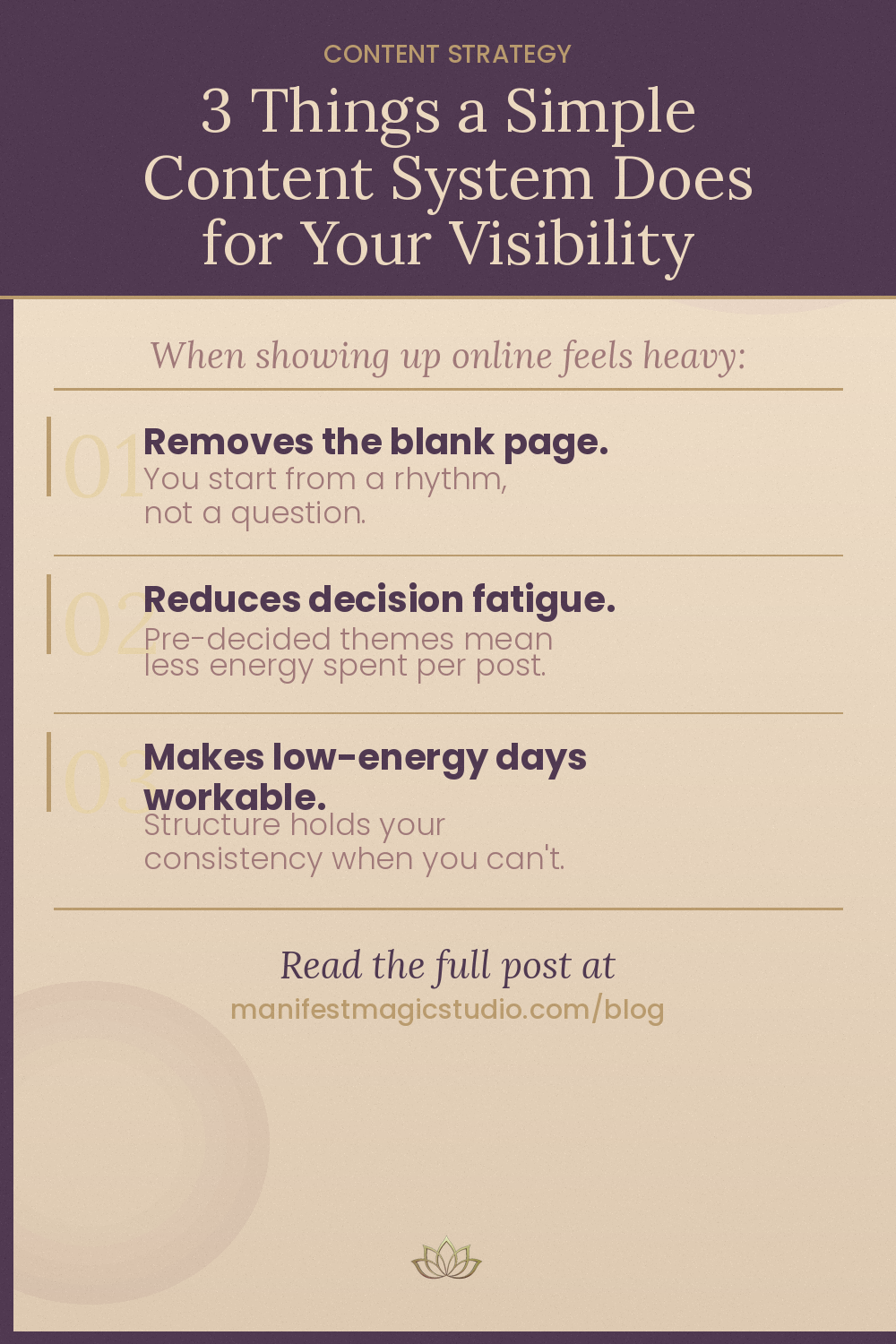
A well-designed content system reduces the number of things you have to figure out each time you sit down to write. It removes the blank page. It removes the "what should I talk about" question. It removes the friction between having something worth saying and actually getting it out of your head and into the world.
When I started keeping one running note on my phone for everyday observations that connect back to my message, my content stopped feeling like an obligation I was avoiding and started feeling like something I was gathering. The shift was quiet and structural, and it made more difference than any strategy I'd tried before.
Another simple content support is noting your comments on others’ posts. Your comments are a goldmine. So often, our comments reveal how we actually think and feel on certain topics. Mine them! I keep a doc on my desktop to record my responses to others’ work, and it’s a perfect place to find content. Already in my own words. Already relating to others’ ideas.
You might choose two or three content themes that reflect your work, your clients' questions, and your own perspective. You might write one main piece each week and pull a short post, an email thought, and a story from that same idea. The key is that the decisions are made ahead of time, so you're showing up to execute, not to strategize from scratch.
That distinction matters enormously when your energy fluctuates, and for most of us, it does.
How Decision Fatigue Shapes Visibility More Than Motivation Does
The conversation around consistency in the online business world tends to center on discipline and willpower. “Show up every day. Batch your content. Post even when you don't feel like it.”
That advice assumes stable energy. And as I've explored in 5 Powerful Shifts to Increase Your Business Capacity Without Forcing, capacity shapes everything, including how available you are to create content that actually feels true.
When your energy fluctuates, a system built on the assumption that you'll have the same creative output on Thursday that you had on Monday will collapse. And when it collapses, the story you tell yourself isn't "the system failed." It's "I failed." That story becomes its own obstacle.
Data from the American Institute of Stress shows that decision fatigue is one of the most consistent contributors to reduced performance and follow-through. When you're making dozens of micro-decisions about your content, what to post, how to say it, whether the tone is right, whether anyone will care, you're drawing from the same cognitive reservoir as every other decision in your business and your life. The reservoir empties. The content stops flowing. You disappear for ten days and then feel ashamed about it.
A simple content system addresses this at the root by pre-deciding. You set the themes. You establish the rhythm. You make the structural decisions once, so that every future execution is just a smaller, calmer question: which part of my system am I using today?
A Simple Content System Should Feel Like Support, Not a New Standard to Meet

The Difference Between a System That Holds You and One That Pressures You
This is where I want to be careful, because systems can go either way.
A system that holds you gives you a place to begin when energy is low. It makes repeating a message in different forms feel like good strategy rather than running out of ideas. It keeps your content ideas, stories, and client insights somewhere accessible so you're not starting from zero every week. It gives your audience a sense of familiarity and rhythm, which builds the kind of trust that leads to sales without you having to pitch loudly or perform consistently.
A system that pressures you adds standards you feel obligated to meet. It creates a definition of consistency that requires you to override your body. It turns showing up into something you either execute perfectly or fail at. That kind of system makes the visibility problem worse, not better.
As I wrote in Consistency Is the Quiet Skill That Changes Everything, real consistency isn't about volume. It's about rhythm. And rhythm is something a good content system can hold for you, even on the days when you can't hold it yourself.
The goal is content that feels like communication, not performance. Writing that sounds like you actually said it, because you did. A process that makes showing up possible on ordinary days, not just the days when everything feels aligned and the words come easily.
What Steady Visibility Actually Requires
Steady visibility doesn't require more confidence. It requires less resistance. And resistance usually lives in the decisions, not in the showing up itself.
When you remove the decision about what to post, when to post, and whether your ideas are worth sharing, you're left with a much simpler task. You already have your message. You already have your perspective. You already have the experience your audience needs to hear about. The system just creates the container where all of that can move without friction.
That's what I care about building with the women I work with. A way of showing up that fits the way they actually move through the world, that respects fluctuating energy, that makes content feel like something they can return to rather than something they have to recover from.
If a simple content system sounds like what your visibility needs right now, the Social Spell Collective is a free starting point. It's a calm, steady content space built for spiritually attuned women who want to stay visible without the weight of figuring it out from scratch every week. Come and look around when you're ready. There's no pressure and nothing to perform.
Frequently Asked Questions
A Simple Content System for Steady Visibility
What is a simple content system for entrepreneurs?
A simple content system is a repeatable structure that removes the guesswork from showing up online. Instead of deciding what to post from scratch every week, you pre-decide your themes, your format, and your rhythm so that execution becomes the only remaining task.
For entrepreneurs with fluctuating energy, a simple content system reduces decision fatigue and makes consistent visibility possible without requiring constant creative output.
Why does content creation feel so emotionally draining for some business owners?
For sensitive and intuitive entrepreneurs, content creation carries weight beyond marketing. Showing up online can activate feelings of being watched, judged, or misunderstood, and those feelings create real cognitive and emotional load.
When each piece of content requires overriding that discomfort while also making creative decisions, the task becomes far more expensive than it appears on the surface. A simpler process with fewer decisions reduces that cost significantly.
How does decision fatigue affect content consistency?
Decision fatigue happens when repeated choices drain the cognitive energy available for follow-through. For business owners who are already managing client work, life demands, and the emotional load of visibility, each micro-decision about content, what to say, how to say it, when to post, whether it's good enough, draws from a finite reservoir.
When that reservoir empties, consistency breaks down. The solution isn't more motivation. It's fewer decisions built into the structure from the start.
What should a content system include for sensitive entrepreneurs?
A content system for sensitive entrepreneurs works best when it includes two or three recurring content themes that reflect your work and your clients' questions, a simple weekly format such as one main piece of content that gets pulled into shorter posts and a story, and one place to capture everyday observations that connect back to your message.
The goal is to make the starting point smaller and calmer, so showing up feels like returning to something familiar rather than beginning from zero.
Is a content system the same as a content calendar?
A content system and a content calendar serve different purposes. A content calendar tracks what gets posted and when, but it still requires you to generate the ideas, make the decisions, and fill the slots. A content system makes those upstream decisions in advance, so the calendar, if you use one, becomes easy to fill.
For entrepreneurs who feel drained by the performance side of visibility, the system does the heavy lifting that the calendar never could.
How does repeating your message help build trust with your audience?
Repetition builds familiarity, and familiarity builds trust. When your audience encounters your message consistently across different posts and formats, they begin to recognize your perspective and associate it with reliability.
Many business owners worry that repeating themselves will feel annoying or redundant, but for most audiences, hearing a message multiple times in different forms is what moves them from awareness to genuine connection. A content system makes that repetition feel natural rather than forced.
What's the difference between visibility and performance online?
Visibility means showing up in a way that communicates clearly and consistently who you are and what you offer. Performance means showing up in a way that prioritizes impression management, output volume, or audience reaction over authentic expression.
For many sensitive entrepreneurs, the pressure to perform is what makes visibility feel unsustainable. A content system that centers your actual message and your natural communication style supports visibility without requiring performance.
Can a content system help with inconsistency caused by low-energy days?
Yes, and this is one of the most important things a content system does. Most visibility strategies assume stable energy, which means they work well on good days and collapse on hard ones.
A content system designed for fluctuating capacity makes decisions in advance, keeps the starting point simple, and removes the blank page so that showing up on a low-energy day requires the smallest possible lift. The structure holds consistency even when motivation and capacity are temporarily lower.
How do I know if my content system is too complicated?
If your content system adds decisions rather than removing them, it's too complicated. Signs include feeling overwhelmed when you open your content planning tools, spending more time organizing the system than using it, or finding that you still face a blank page even with the system in place.
A well-designed content system should feel like relief when you sit down to create, not like another obligation to manage.
What is The Social Spell Collective?
The Social Spell Collective is a low-cost monthly community for spiritually attuned women entrepreneurs who want steady visibility without the decision fatigue of creating content from scratch. Free members receive monthly content themes that easily translate into posts.
Paid members receive done-for-you social posts and SEO blog content designed to reduce the friction between having something to say and actually showing up to say it. It's built for business owners with fluctuating energy who want a content rhythm they can sustain without burning out or disappearing.