Why Consistency Fails Without Emotional Capacity: The Real Reason You Can’t Stay Consistent in Your Business
Last updated: 28 March 2026
Why Consistency Fails without Emotional Capacity is the real answer to the question you’ve probably asked yourself more than once: why can’t I stay consistent in my business even when I care about it and know what to do? The answer comes down to capacity, not discipline, and once you see it, everything starts to make sense.
Like me, you’ve probably lived this more than once. You start showing up consistently, your ideas feel clear, and your content starts landing in a way that feels aligned.
When Your Nervous System Shifts, Consistency Shifts With It
Then a client cancels, and something in your body shifts before your brain even has time to explain it. You sit down to create, and the same process that felt easy a few days ago suddenly feels heavier and harder to access.
“I’m exhausted from trying to do business the right way” starts to feel more true than you want it to. That thought comes from a nervous system that is trying to hold more than it can comfortably support.
Research from the American Psychological Association shows that chronic stress directly impacts decision-making and cognitive clarity, which directly affects follow-through and consistency over time (https://www.apa.org/pubs/reports/work-in-america/2023-workplace-health-well-being). When your system feels pressure, your ability to execute shifts with it.
Staying consistent has always been tied to capacity, even if no one taught it that way. Structure supports capacity and allows you to grow your business in a way that feels steady and sustainable.
Emotional capacity in business explains what actually breaks consistency
Emotional capacity in business describes how much your system can hold before it starts conserving energy, slowing decisions, and pulling back from output. It shows up in subtle ways first, and most people miss it until it turns into inconsistency.
When your capacity is available, everything feels smoother. You open your laptop and know what you want to say, your message feels clear, and your brain moves through decisions without friction.
When your capacity drops, those same steps start to stretch out. You reread things, question your direction, and feel like you need more time to land something that used to take minutes.
That shift is predictable. It isn’t random, and it isn’t personal.
Widely-taught business structure expects you to operate with steady energy. Your nervous system moves in cycles based on load, pressure, and recovery, and it adjusts constantly behind the scenes.
When your structure and your capacity fall out of sync, consistency breaks. If you want to understand this deeper, this post on nervous system safety in business explains how your internal state directly impacts your ability to show up.

Why Consistency Fails without Emotional Capacity during growth phases
Growth adds weight before it adds stability. More visibility creates more decisions, and more attention creates an unspoken pressure to maintain what you started.
That’s where a lot of women hit a wall they don’t expect. Things begin working, and instead of feeling relief, there’s a subtle tightening underneath it.
“As soon as things start working, I panic,” becomes a quiet truth that’s hard to explain out loud. That response makes sense when your system is trying to calculate whether you can sustain what you’ve created.
If your structure relies on you feeling clear, available, and steady every day, growth will eventually push you past your current capacity. When that happens, your system pulls back to create space.
Harvard Business Review explains that elevated stress levels reduce cognitive flexibility and long-term strategic thinking, which directly impacts your ability to maintain consistent output (https://hbr.org/2015/01/the-biological-cost-of-stress). Your brain shifts toward protection when demand rises without support.
That pullback isn’t inconsistency. It’s nervous system regulation.
The hidden cost of chasing consistency without capacity
Most business strategies focus on output without accounting for the internal cost of maintaining it. The advice sounds simple on the surface, which makes it easy to follow and hard to sustain.
You show up daily, push through resistance, and keep your visibility high. For a while, it works well enough to reinforce the idea that consistency comes from effort.
Then your system starts to feel the strain. Decisions take longer, your tolerance for pressure drops, and eventually you step back to recover.
This creates a cycle that feels frustrating because it repeats. You build momentum, lose it, rebuild it, and question yourself every time it drops again.
Gallup reports that 76% of employees experience burnout at least sometimes, which reflects what happens when demand continues without enough structural support (https://www.gallup.com/workplace/288539/employee-burnout-biggest-myth.aspx). That same pattern shows up in business when consistency depends on personal energy alone.
If your content rhythm keeps collapsing after periods of consistency, this post on why most social media strategies miss the point will help you see the structural gap.

The simple structure that holds consistency on low-energy days
Consistency becomes steady when your system reduces the number of decisions you have to make each day. The goal isn’t to push harder. The goal is to create a structure that works when your energy fluctuates.
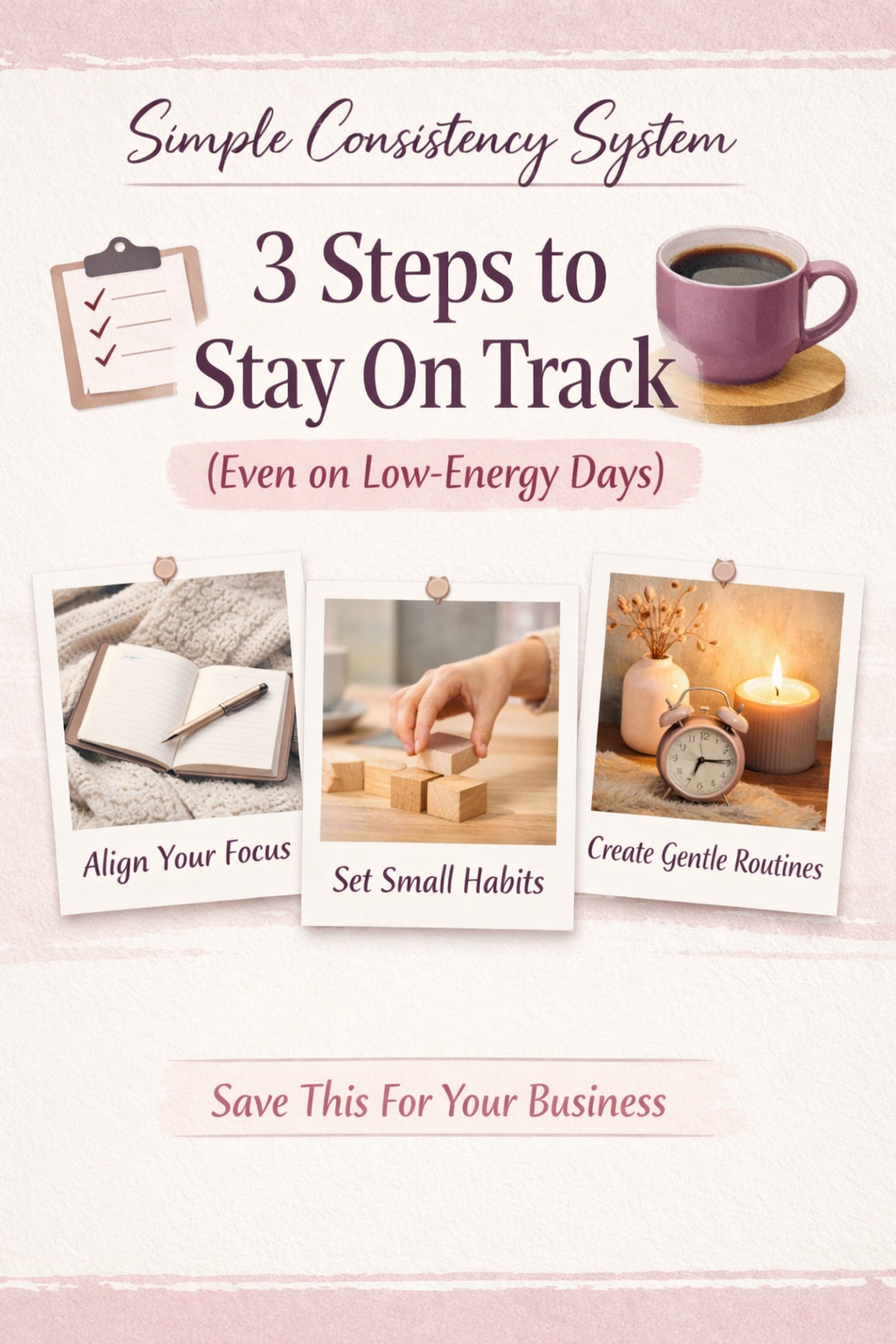
Start by choosing three types of content that feel natural for you to create. Teaching, personal insight, and client reflections work because they mirror how you already process your experiences.
Assign each type to a specific day so your brain follows a rhythm. When you sit down to create, you already know what belongs in that space, which reduces hesitation.
On low-energy days, scale the output down to match your capacity. One idea, one paragraph, and one clear point is enough to maintain consistency.
This works because it removes pressure while preserving momentum.
If you want a more supported version of this, this post on calm visibility systems that increase consistency without burnout walks you through how to build it out.
What shifts when emotional capacity leads your strategy
When your systems support your capacity, your relationship with your business changes in a way that feels subtle at first and then becomes obvious. You stop negotiating with yourself every time you sit down to work.
Your decisions feel cleaner because you’re not carrying as much pressure. Your content becomes more consistent because your structure absorbs the fluctuation in your energy.
Over time, that steadiness builds trust with your audience. They experience your presence as reliable, which creates a different kind of connection than bursts of intensity ever could.
Stanford Medicine research shows that prolonged stress exposure impacts recovery capacity and cognitive function, which directly affects how consistently you can execute over time (https://med.stanford.edu/news/topics/stress.html). When your system feels supported, your output stabilizes naturally.
If your capacity has been fluctuating more than your strategy accounts for, this post on how to grow your business without burnout will help you recalibrate in a way that feels sustainable.

The real reason you can’t stay consistent in your business
When your nervous system carries most of that business weight, your output fluctuates because your energy fluctuates.
When structure carries more of that responsibility, your system has space to stay regulated and steady. That shift changes everything about how your business feels day to day.
You start showing up with less resistance and more clarity. You trust your rhythm because it works with your capacity instead of pushing past it. That’s when consistency becomes something your business supports instead of something you have to force.
Frequently Asked Questions
1) Why can’t I stay consistent in my business?
Consistency usually drops when emotional capacity drops. When your system feels overloaded or under-supported, your brain reduces output to protect your energy, which shows up as inconsistency.
2) Is consistency really about discipline?
Consistency is supported by structure more than discipline. Systems that reduce decisions and match your capacity create more reliable consistency than motivation alone.
3) How do I stay consistent on low-energy days?
Use a simplified structure that removes decision pressure. Pre-decide your content types, assign them to days, and reduce your output to one clear idea so you can maintain visibility without overwhelm.
4) What is emotional capacity in business?
Emotional capacity refers to how much pressure, decision-making, and visibility your system can hold before it needs recovery. When capacity is supported, consistency becomes easier to sustain.
If a calmer system that removes decision fatigue and gives you steady visibility would feel supportive right now, you can explore it here: The Social Spell Collective on Skool.