
How to Create Brand Documents: A Practical Setup Guide for Spiritual Small Business Owners

Last updated: January 21, 2026
How to create brand documents becomes urgent when content feels scattered, collaboration feels draining, or every new idea creates more confusion than momentum. Many spiritual small business owners sense something feels off long before they name the issue.
Brand documents bring structure to intuition. They reduce decision confirming. They protect energy, time, and income.
This guide walks through the exact documents to create, what belongs inside each one, and how to use them as living infrastructure.
Brand documents for small business that reduce overwhelm and protect your energy
Why brand documents matter before strategy or content
Spiritual business owners rely on intuition. Intuition needs structure to move consistently.
Brand documents act as a reference point when energy dips, when ideas multiply, or when outside voices grow loud. They create steadiness across content, offers, and collaborations.
Without brand documents, every decision requires fresh energy. With brand documents, decisions feel settled.
This is infrastructure, not busywork.
What brand documents actually are
Brand documents collect the core truths of your business in one place.
They define how you speak, who you serve, what you offer, and where boundaries live. They remove guessing.
A complete set fits inside one Brand Bible, organized into clear sections that can be shared or referenced separately.
The core brand documents every spiritual business needs
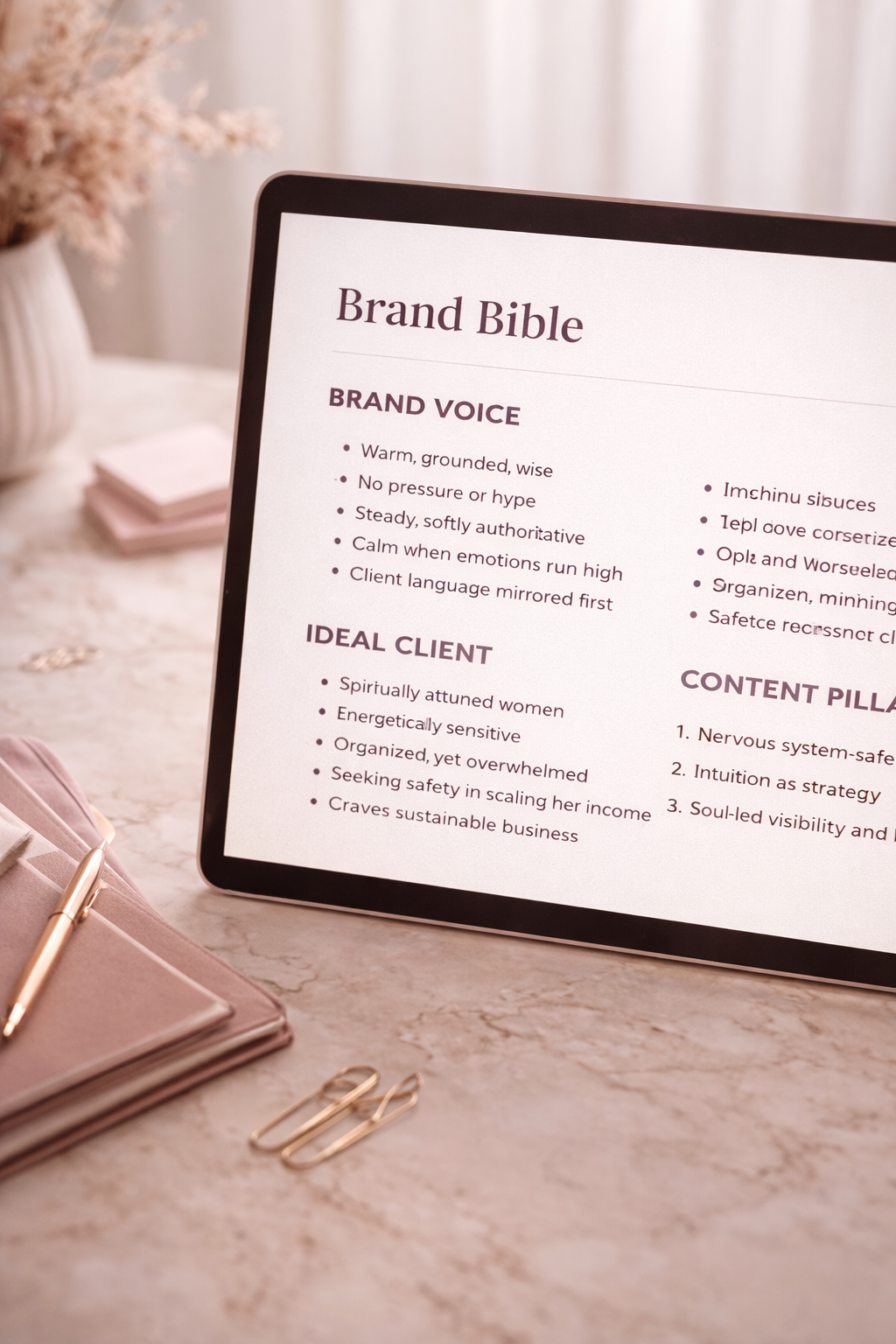
Brand vision and values
This section names what your business stands for and what it refuses to compromise.
Include:
The purpose of your work
The values that guide decisions
The pace you protect
The standards you expect in collaboration
This section anchors everything else.
Ideal client profile and audience language
This section defines who your work supports and how they describe their inner experience.
Include:
Needs and desires
Fears and frustrations
Language they use when speaking privately
Light demographics and relevant psychographics
This document shapes content, offers, and messaging tone.
Brand voice and communication guidelines
This section explains how your brand sounds across platforms.
Include:
Tone descriptors
Sentence length preferences
Words you repeat
Words you avoid
Emotional range you hold
This protects consistency when energy fluctuates or when others write on your behalf.
Offer ecosystem and scope boundaries
This section clarifies what you offer now and how future ideas get evaluated.
Include:
Current services and products
Who each offer serves
What stays outside scope
Criteria for adding new offers
This section prevents overextension and scattered launches.
Content pillars and strategic focus
This section defines what topics you return to and what you leave behind.
Include:
Three to five core themes
How each theme supports your offers
Examples of content that fits
Examples that fall outside scope
This simplifies content planning and protects creative energy.

How to create brand documents without overthinking
Start with one document. Use simple language. Write as if explaining your business to someone you trust.
Answer questions directly. Skip polishing. Clarity matters more than style.
Many business owners choose a Google Doc with clear headings and separate tabs for each section. This allows easy sharing with collaborators while keeping everything housed in one place.
How brand documents support social media managers and collaborators
Social media managers, marketers, designers, and copywriters work best with clear inputs.
Brand documents reduce revision cycles. They prevent misinterpretation. They protect both parties.
For service providers, brand documents act as required intake. For business owners, they protect time, money, and emotional bandwidth.
When to revisit and update your brand documents
Brand documents evolve as your business evolves.
Revisit them:
Before launching something new
After a major life or business shift
When content starts to feel heavy
When visibility increases
Updates feel easier when the foundation already exists.
A calmer way to build your Brand Bible
Creating brand documents can feel heavy when energy runs low or time feels tight.
I created a guided system that uses custom GPTs to walk you through each section in a grounded, step by step sequence. The system produces a complete Brand Bible you can use immediately.
If support would help, the option is here.
